
Ultrasonic method · La Puente & West Covina, CA · Above the audible
Ultrasonic Leak Detection in La Puente & West Covina, CA
The smallest leaks speak in frequencies human ears never rent: fine sprays and pinhole hisses whose energy concentrates in the ultrasonic band, above hearing, below notice. Sensors tuned to that band hear a whisper the room calls silence. (626) 898-6169 tunes in.
Why small leaks go high
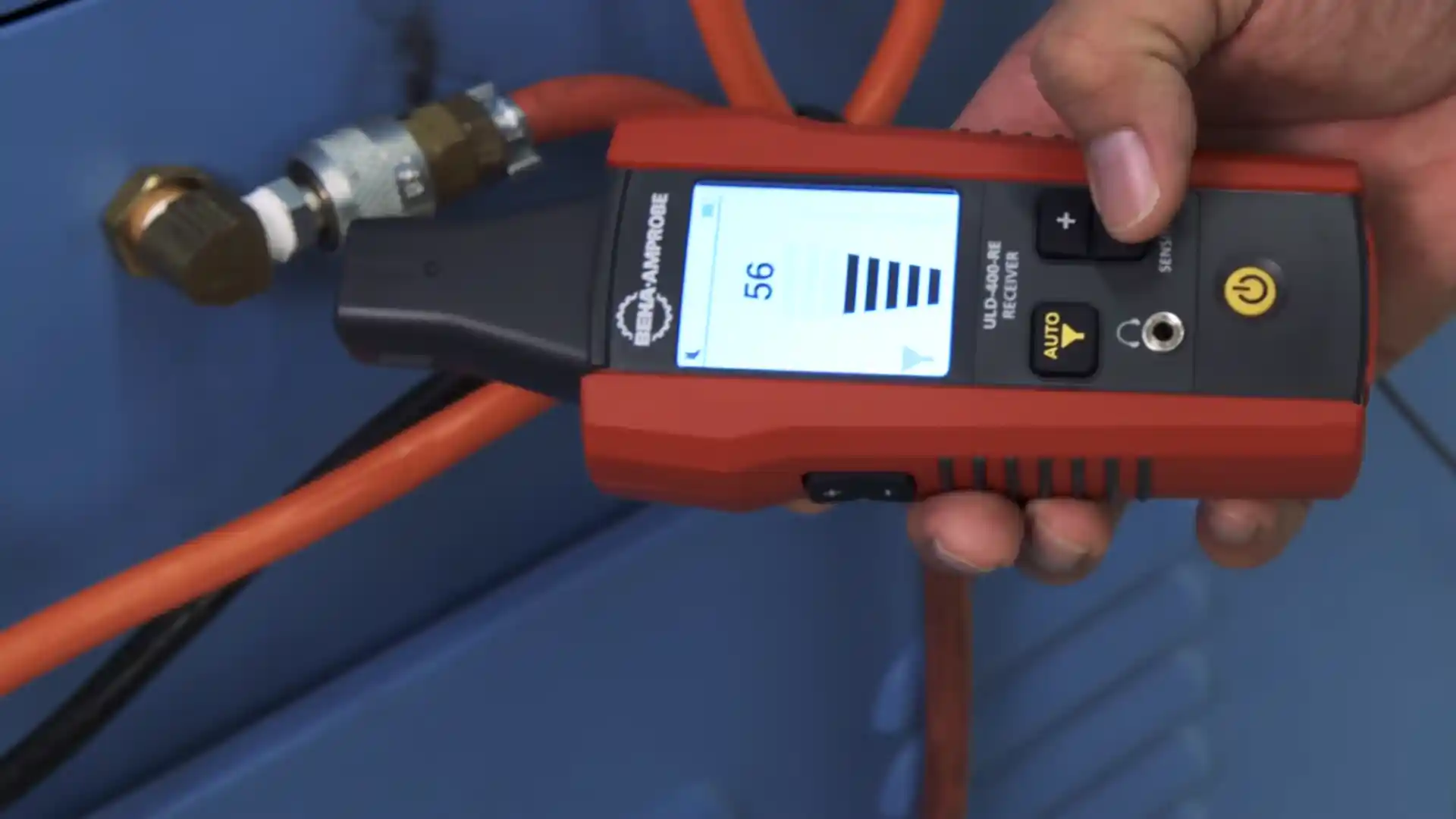
Sound frequency tracks the geometry of its source. Big openings move a lot of water slowly and rumble low; tiny openings force water through fast, and the turbulence they shed peaks high, into ultrasound. A pinhole’s fine jet, the seep past a barely open valve seat, the mist from a hairline in a fitting: their loudest voices live above the audible ceiling, which is why a room can sound perfectly quiet while a sensor registers a scream.
Ultrasonic receivers translate that band down to headphones and meters, and because ordinary household noise is mostly low-frequency, the high band arrives remarkably clean: the leak, and very little else.
Airborne and contact: two ways to catch the band
Airborne sensing sweeps the ultrasound traveling through air, ideal for leaks with any path to the open: fixture connections, equipment rooms, cabinet interiors, spa bays, and commercial ceilings. The signal is directional, so the sensor points like a flashlight and intensity rises as it faces the source. Contact sensing presses a probe to pipe, valve, or slab and reads the ultrasound conducted through the material itself, reaching failures that airborne sweep cannot, and confirming which fitting in a crowded manifold is the one whispering.
The Old Town storefronts’ back rooms, all valves and aging fittings above suspended ceilings, are a natural habitat for the airborne sweep; contact work earns its keep at manifolds and meters everywhere.
The valve-seat specialty
One job belongs to ultrasound almost alone: convicting a valve that no longer fully closes. A weeping seat passes a thread of water whose ultrasonic signature reads plainly at the valve body, on a fixture stop, an irrigation valve, a pool valve, or a main. It is how we answer, without disassembly, the constant field question of whether the zone that keeps dampening is fed by its valve or by a pipe, and it converts a manifold of suspects into one signed confession.
On pressurized systems generally, the method also grades severity: signal strength tracks flow through the breach, useful when triaging which of two known problems the budget fixes first.
Where ultrasonic sits in the toolbox
Think of ultrasonic as the fine brush. Acoustic ground work finds the neighborhood; ultrasound identifies the house. It closes the cases other methods leave ambiguous: which of three fittings, which valve on the manifold, whether the hiss behind the panel is water or the building breathing. It also runs first in equipment-dense spaces, spa cabinets, laundry walls, commercial mechanical rooms, where its directionality untangles crowded sound.
Small leaks caught in the whisper stage are the cheapest repairs on this site. The high band is listening at (626) 898-6169.
Ultrasonic questions from the high band
How is this different from the acoustic detection page?
Frequency and range. Acoustic ground work listens in bands that travel well through soil and slab, built for locating leaks at depth and distance. Ultrasonic listens far higher, where tiny leaks concentrate their energy but where signals fade quickly, built for precision up close. They are siblings with different jobs, and a thorough search often uses both: acoustic to arrive, ultrasonic to point.
Can it hear a leak with the water barely flowing?
Within limits, and often better than anything else can. The fine flows that defeat other methods, a seep past a valve, a mist from a pinhole, are precisely the high-frequency sources ultrasound favors. What it cannot do is conjure signal from zero flow: a leak must be leaking during the survey. We test with the system pressurized and, where relevant, cycle valves to make shy seeps speak.
The sensor pointed at my wall outlet. Should I worry?
Not about water, usually. Ultrasonic receivers hear everything in their band, and electrical arcing inside a worn outlet or switch emits there too. It is a useful accidental finding, worth an electrician’s glance, and a good illustration of the method’s honesty: it reports the band faithfully, and interpretation sorts water from sparks from the neighbor’s ultrasonic pest gadget.
A question we did not answer here is a call we are glad to take: (626) 898-6169.
Related services & areas
The fine brush finishes work that starts on these pages.
Eight methods, one discipline
Instruments first, evidence always, and a mark worth trusting before anything opens. The toolbox answers the phone.
☎ Call (626) 898-6169 · 24/7