
Thermal method · La Puente & West Covina, CA · Seeing temperature
Thermal Imaging Leak Detection in La Puente & West Covina, CA
Every surface glows in infrared, and water rewrites the glow. A hot supply line leaking under a slab paints a warm plume across the floor above it; a wet wall cools itself by evaporation and shows dark against dry neighbors. The camera sees both stories at once. (626) 898-6169 reads them.
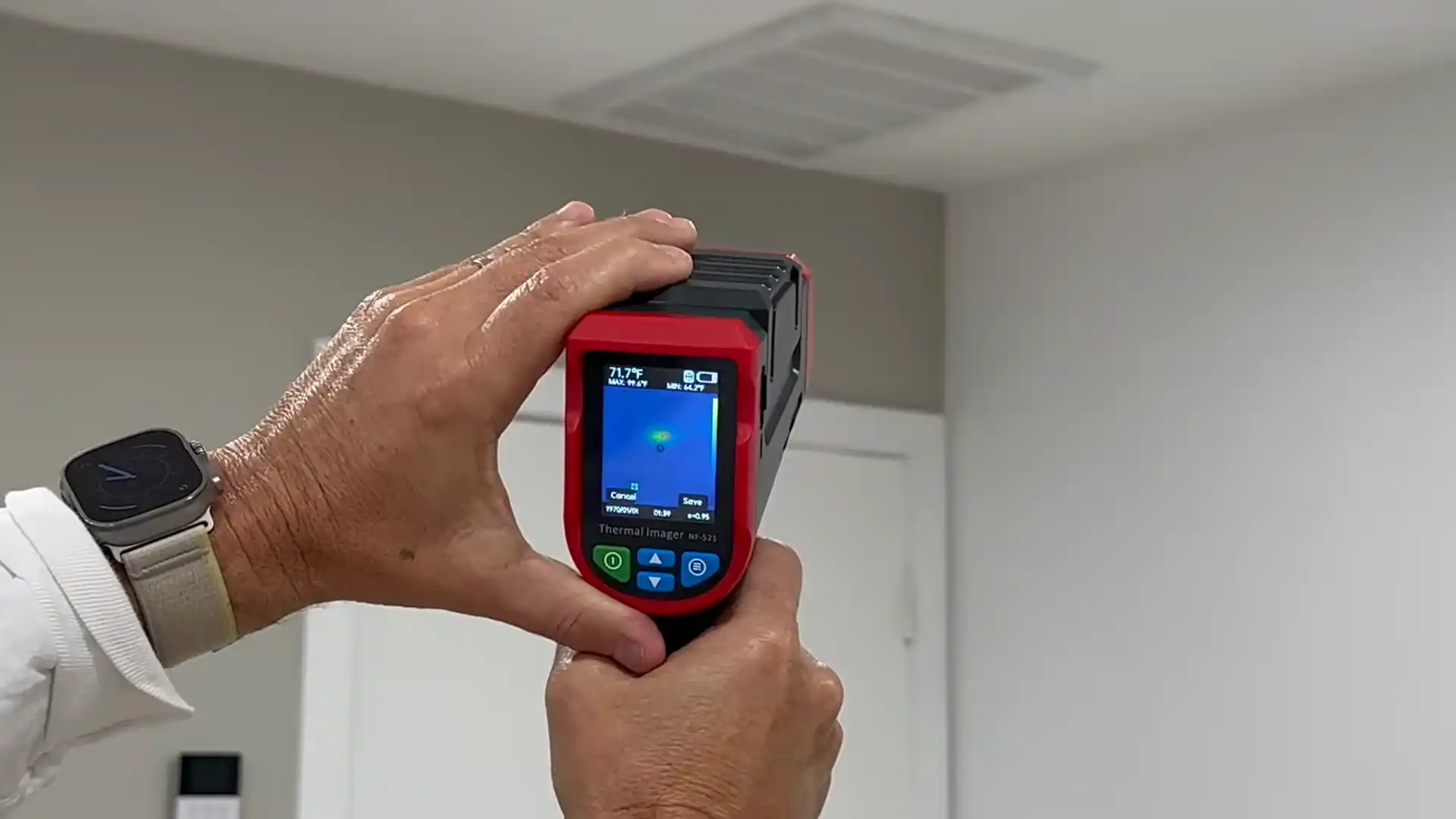
What the camera actually sees, and what it does not
An infrared camera measures the temperature of surfaces, nothing more and nothing less. It does not see through walls, floors, or slabs; it sees the face of them, in exquisite thermal detail. Leak detection with IR therefore works by signature: heat or coolness that a hidden condition has conducted, convected, or evaporated onto a surface the camera can view. The skill is knowing which signatures mean water and which mean sun, ducting, or a wall stud doing ordinary stud things.
That honesty about the tool matters, because thermal images look authoritative and are easy to over-read. Ours come annotated with what the pattern is, what else it could be, and what confirming test settles it.
The two signatures: warm plumes and cool evaporation
Signature one is heat. A hot-side line leaking beneath a slab warms the concrete above it, and the camera renders the plume: a bright bloom, often elongated along the pipe run, unmistakable against a cool floor. It is the fastest slab-leak triage in existence, and on the hot-water failures the local copper cohort produces, frequently the first confirmation of the day. Signature two is cold. Wet material evaporates, evaporation cools, and saturated drywall or stucco reads darker than its dry surroundings, mapping the moisture’s extent even when the water itself is cold.
Inland afternoons help: the strong thermal gradients of an East La Puente summer make both signatures pop against sun-warmed structure, and we schedule scans to exploit the contrast.
Where thermal leads and where it assists
Thermal leads on hot-line slab leaks, radiant loops, and any search where the water carries a temperature the structure does not. It assists everywhere else: framing the wet zone on wall and ceiling investigations before the moisture meter maps contours, sweeping large areas fast to decide where slower tools should concentrate, and documenting dry-out progress after repairs with before-and-after frames.
Its blind spots route the case onward: cold leaks under thick slab may show nothing, drains rarely announce thermally, and exterior scans fight the sun’s own painting. Those hand to acoustic, camera, or tracer gas, and the pages for each say how.
The scan, the annotations, and your copy
A thermal visit scans systematically, floors along known runs, walls below wet rooms, ceilings under suspects, with fixtures cycled hot to make shy signatures speak. Frames worth keeping get logged with visible-light pairs so future readers know what they are looking at, and the annotated set joins your documentation, which insurance adjusters receive gratefully and skeptics receive convincingly.
Fast, silent, and touch-free, it is the method most homeowners find the most persuasive to watch. Book the lens at (626) 898-6169.
Infrared questions from behind the lens
Can the camera find a cold-water leak?
Often, by the second signature. Cold supply water under a slab can read as a subtle cool zone, and once any leak wets material, evaporative cooling marks the moisture regardless of the water’s original temperature. Hot leaks simply shout where cold ones whisper. When a cold-line search whispers too softly, acoustic and tracer methods take the lead and the camera documents.
Why did the scan happen in late afternoon?
Contrast is the camera’s fuel. After a warm day, structures hold thermal gradients: sun-warmed surfaces, cooler shaded ones, and any anomaly a leak has written stands out against the spread. A thermally flat morning can hide a signature that afternoon reveals. We schedule scans, and sometimes re-scans, around the physics, because the same leak photographs differently at different hours.
The image shows a cold stripe but the meter says the wall is dry. Who wins?
The meter, and the stripe gets a mundane explanation: a stud, a duct, an exterior shadow, or air movement can all paint cool lines that mimic moisture. This is exactly why our protocol pairs every thermal claim with contact verification. An IR anomaly plus a wet meter reading is evidence; an anomaly alone is a hypothesis, and we treat it as one.
A question we did not answer here is a call we are glad to take: (626) 898-6169.
Related services & areas
Thermal findings pass their cases to these pages.
Eight methods, one discipline
Instruments first, evidence always, and a mark worth trusting before anything opens. The toolbox answers the phone.
☎ Call (626) 898-6169 · 24/7